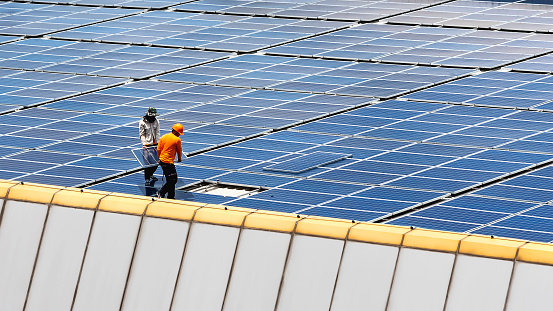

Indonesia is preparing for one of the most ambitious renewable green energy transition projects in its history. The government under President Prabowo Subianto is pushing forward with a plan to build solar power plants with a combined capacity of 100 gigawatts. This shift is a target that reflects the country’s determination to accelerate its transition toward cleaner energy sources while strengthening long-term energy security.
The scale of the project is enormous. According to the Ministry of Energy and Mineral Resources (ESDM), approximately 24,000 hectares of land will be required to support the development of the planned solar facilities. To illustrate the size of that requirement, the area is nearly twice the size of South Jakarta, which spans around 14,127 hectares. In practical terms, the land needed for the project is about 1.7 times larger than the entire South Jakarta region.
Deputy Minister of Energy and Mineral Resources Yuliot Tanjung said that securing sufficient land remains one of the most important steps in ensuring the project can move forward quickly. For that reason, ESDM has been working closely with the Ministry of Agrarian Affairs and Spatial Planning/National Land Agency (ATR/BPN) to identify suitable locations.
“Based on the identification process conducted jointly by the Ministry of Energy and Mineral Resources and the Ministry of ATR/BPN, around 24,000 hectares of land are already available on Java Island,” Yuliot said at the Ministry of Energy and Mineral Resources office.
Although land has been identified, the process is far from complete. The government plans to carry out further verification together with ATR/BPN and state electricity company PT PLN (Persero). The review will assess whether supporting infrastructure is available, including transmission networks and substations that will connect future solar power plants to Indonesia’s national electricity grid.
Alongside preparations on the ground, the government is also working to establish a stronger regulatory foundation. Yuliot revealed that ESDM is currently finalizing a draft Presidential Regulation aimed specifically at accelerating the development of the 100 GW solar initiative.
“The Ministry of Energy and Mineral Resources is finalizing a draft Presidential Regulation for the acceleration of the 100 GW solar power development program. At the same time, while the initiative permit process is running in parallel, we are also conducting discussions with various ministries and institutions so that the regulatory foundation can support the accelerated development of 100 GW of solar power,” Yuliot said.
Read also: Cooler Air Arrives Early in Bali, BMKG Predicts More Until August
The solar expansion program forms part of President Prabowo Subianto’s broader strategy to speed up toward green energy transition in Indonesia. The president has set an ambitious goal of reaching up to 100 GW of installed solar capacity by 2029.
During the Indonesia-Japan Business Forum in Tokyo on March 30, 2026, Prabowo emphasized the government’s determination to move rapidly in developing solar energy.
“We want to move very quickly to utilize electricity from solar energy. We have a plan and we are determined to move as fast as possible. Within three years, we want to achieve 100 gigawatts of solar energy,” Prabowo said.
For the government, the urgency extends beyond environmental goals. Growing geopolitical tensions, particularly in the Middle East, have increased concerns over global energy security and the stability of energy supplies. Those developments have strengthened Indonesia’s resolve to reduce reliance on external energy sources and expand domestic production.
“For us, this is becoming more urgent because the geopolitical situation in the Middle East creates strategic uncertainty for our energy security,” Prabowo stressed.
As part of green transition strategy in Indonesia, the country is not relying solely on solar power. The government is also seeking to maximize other domestic energy resources. The country possesses significant geothermal potential and continues to expand the production of renewable fuels, including B50 biodiesel and bioethanol.
Through the combination of large-scale solar development, geothermal expansion, and biofuel production, Indonesia aims to build a more resilient energy system while reducing vulnerability to external shocks. The planned 100 GW solar project now stands at the center of that effort, representing both a major infrastructure challenge and a key pillar of the nation’s future energy strategy.