




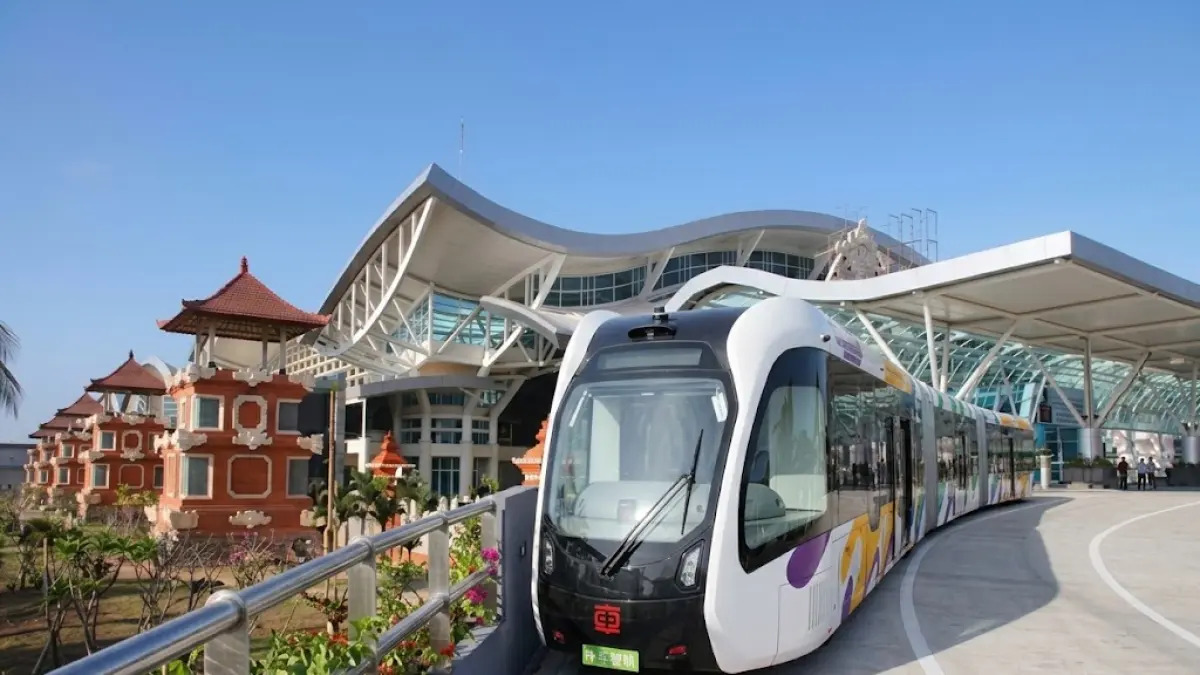

Getting from Bali’s international airport to popular destinations such as Kuta, Legian, Seminyak, and Canggu could become easier in the coming years. The Indonesian government is preparing a new battery-powered electric tram network in Bali designed to improve public transportation and reduce traffic congestion across the island’s busiest tourism corridor.
The proposed project gained further momentum after President Prabowo Subianto held a limited meeting with Kereta Api Indonesia (KAI) President Director Bobby Rasyidin at the State Palace on Thursday, November 5, 2026. The development of Bali’s railway and tram system was among the main topics discussed during the meeting.
Following the discussion, Bobby confirmed that KAI had presented its development plans for the island’s first tram network. The proposed route will connect I Gusti Ngurah Rai International Airport with several major tourism areas before reaching Canggu in Badung Regency.
“We presented the development programme for the railway system in Bali. The first phase of the railway service will run from Ngurah Rai Airport northward, passing through Kuta, Legian, and Seminyak, before reaching its final destination in Canggu,” Bobby said after the meeting.
Rather than constructing the entire network at once, the project will be divided into two development stages. The first phase will establish the connection between Ngurah Rai Airport and Legian, with construction expected to take approximately two years. Once completed, the second phase will extend the route from Legian to Canggu, requiring another estimated two years of construction.
“The Bali railway system, or Bali tram, will also be developed in two stages. The first phase will run from Ngurah Rai to Legian, followed by the second phase from Legian to Canggu. That will also take two years,” Bobby explained.
The estimated investment for the project exceeds IDR 2 trillion. Bobby confirmed that this figure had been presented during the meeting as the proposed budget for developing the Bali railway system.
“We have proposed a budget of more than IDR 2 trillion for the Bali railway project,” he stated.
Read also: Ijen Geopark Retains UNESCO Global Geopark Status with Green Card Recognition
Land acquisition is another consideration that has already been included in the project’s planning. Bobby said the matter had been taken into account as part of the preparations for Bali’s first tram network. The project is also expected to be developed directly by KAI.
A 12-Kilometre Route Designed for Bali’s Busiest Tourism Areas
The proposal is not entirely new. The Bali Provincial Government had previously disclosed plans to introduce battery-powered electric trams connecting I Gusti Ngurah Rai International Airport with Canggu, one of the major tourism destinations in Badung Regency.
Under the initial design, the railway corridor will stretch approximately 12 kilometres between the airport and Canggu. The infrastructure is planned to feature two tracks, together with designated crossing sections to support smooth and efficient tram operations.
The vehicles will also have a relatively compact design to suit the available corridor. The proposed track area will measure approximately three metres in width, while each tram will be slightly more than two metres wide. This means the vehicles could be even narrower than conventional buses.
The compact design is expected to help accommodate the tram system within Bali’s existing transportation corridors. Connecting the airport with Kuta, Legian, Seminyak, and Canggu would also provide an alternative way for residents and visitors to travel between several heavily visited areas.
Can the Tram System Help Reduce Traffic Congestion in Bali?
Traffic congestion has become a major challenge in Bali, particularly across Badung Regency. The airport-to-Canggu corridor experiences substantial daily movement from both residents and tourists, placing considerable pressure on existing road infrastructure.
According to preliminary estimates, approximately 150,000 people travel through this area every day, alongside around 80,000 vehicles. These figures highlight the need for additional transportation infrastructure capable of accommodating growing mobility demands.
The proposed electric tram network is expected to offer an alternative to private cars and motorcycles. By providing a public transportation connection between major tourism areas, the project aims to reduce road congestion, improve accessibility, and strengthen connections between different parts of the island.
Its benefits are expected to extend beyond local residents. Tourists travelling between Ngurah Rai International Airport and popular destinations such as Kuta, Legian, Seminyak, and Canggu could also benefit from a more integrated transportation option.
The system is being designed to accommodate substantial passenger volumes. Under maximum operating conditions, the trams are projected to carry approximately 15,000 to 20,000 passengers, with a journey time of around 30 minutes.
Departures are planned at intervals of approximately 10 minutes. If the service operates at its full potential, its total daily passenger capacity could reach around 60,000 people.
This capacity is expected to help accommodate approximately 40 percent of the mobility demand along the airport-to-Canggu corridor. The target reflects the project’s potential role in reducing dependence on private vehicles and easing pressure on some of Bali’s busiest roads.
Bali Tram Construction Targets 2027 Groundbreaking
The development is expected to follow a multi-year construction schedule, with the initial groundbreaking targeted for March 2027.
According to the preliminary timeline, the first section of the network is expected to begin operations in 2028. This initial stage will cover the connection between Ngurah Rai International Airport and Legian.
The second phase will then continue construction towards Canggu. The complete route, extending from the airport to Canggu, is targeted to be finished and operational in 2029.
With an estimated investment of more than IDR 2 trillion, the project represents a significant transportation development for Bali. Its implementation will involve infrastructure construction, land acquisition, and coordination between KAI and the relevant government authorities.
If completed according to schedule, the battery-powered tram network could introduce a new public transportation option for one of Indonesia’s busiest tourism destinations. Beyond improving connections between the airport and major visitor areas, the project is expected to support local mobility and address the growing pressure on Bali’s road network.