



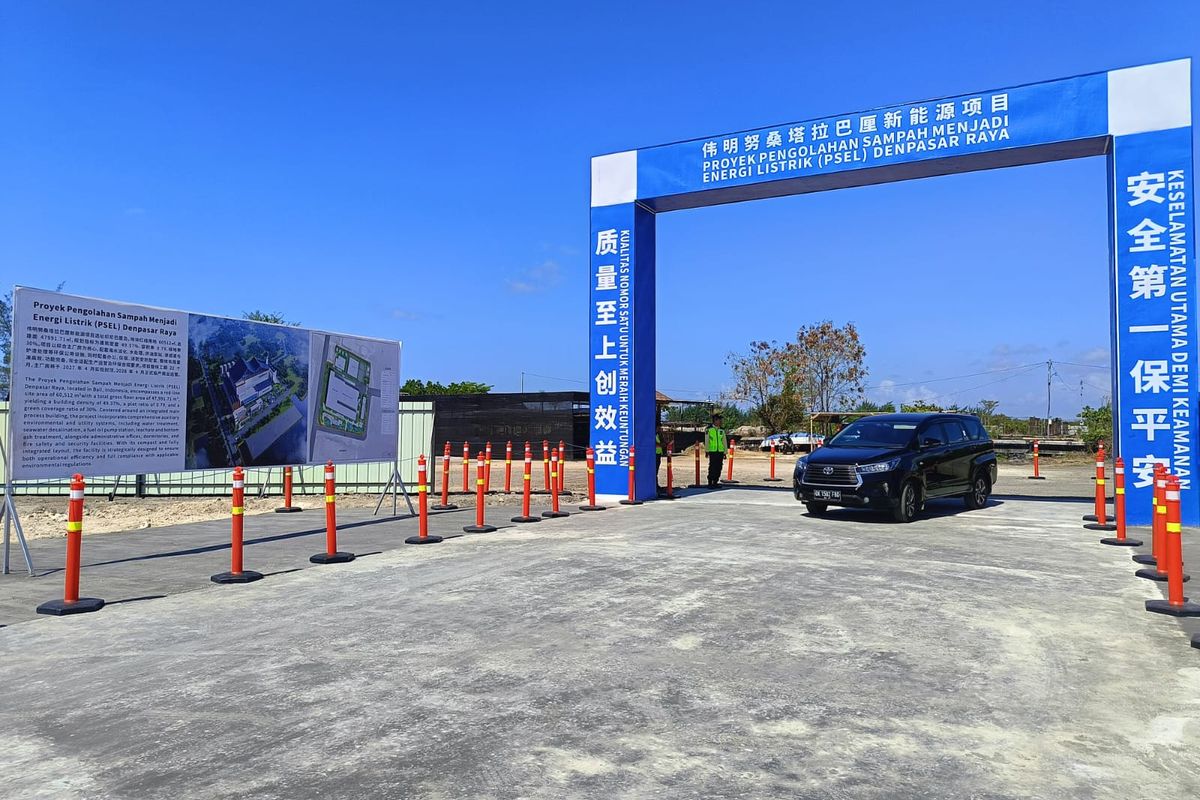

Bali is taking another step toward addressing its growing waste problem by turning accumulated rubbish into a source of electricity. A major Waste-to-Energy (WTE) facility currently under construction in the province has passed the 26% completion mark, bringing the government closer to its plan to transform waste management across several regions of Indonesia.
Coordinating Minister for Food Affairs Zulkifli Hasan recently visited the construction site in Denpasar to review the project’s progress. During the inspection on Wednesday, he confirmed that the Bali facility had reached more than 26% completion.
“Yes, this is the third WTE facility, and the one in Bali has already reached more than 26% progress,” Zulkifli Hasan said during the visit.
The project officially began its construction phase with a groundbreaking ceremony on July 8, 2026. Its primary purpose is to process waste generated in Denpasar City and Badung Regency, two areas that have been dealing with significant waste management challenges.
For the government, the inspection was more than a routine progress review. Zulkifli Hasan said he wanted to demonstrate that the national policy addressing Indonesia’s waste emergency was moving beyond plans and announcements. The government has faced skepticism over whether its proposed waste management initiatives would actually materialize, making visible progress an important part of demonstrating its commitment.
“Our policy to address the waste emergency is making visible progress, as everyone can see for themselves. Many people didn’t believe it and dismissed it as nothing but talk,” he said.
The Bali project is also part of a wider national effort to accelerate the development of waste-to-energy facilities. According to Zulkifli Hasan, the WTE facility in Palembang is scheduled to be completed on December 8. It will undergo commissioning before its official inauguration.
His inspection schedule also extends beyond Bali. After reviewing the construction progress in Denpasar, he plans to visit WTE projects in Bogor, Bekasi City, and other locations, including Bantar Gebang.
Read also: Bali Isn’t the Only Choice Anymore as These Indonesian Destinations Gain Popularity
The government expects physical construction of the Bali facility to be completed in 2027, with operations targeted to begin in December of that year. At the national level, Zulkifli Hasan aims to resolve the waste emergency affecting various regions between 2027 and 2028.
One of the main objectives of the project is to address the environmental damage caused by the accumulation of untreated waste. Large waste piles have become a serious concern because they contribute to air pollution, contaminate water sources, and generate microplastic pollution.
Rather than allowing these problems to continue, the WTE facility is designed to process accumulated waste and convert it into electricity that can be used by local communities.
Zulkifli Hasan highlighted the potential environmental and social benefits of this approach, explaining that waste currently posing a threat to public health could become a useful source of energy.
“These mountains of waste, which once posed a serious threat to our lives through microplastics, polluted air, and contaminated water sources, can now be converted into electricity capable of providing lighting for 50,000 homes,” he said.
The Bali facility is expected to generate enough electricity to supply approximately 50,000 households. This capacity would allow waste that was previously considered an environmental burden to become a resource with direct benefits for the surrounding population.
Its processing capacity is also substantial. Zulkifli Hasan stated that the facility will be capable of handling up to 500,000 tonnes of waste annually, equivalent to approximately 1,000 to 1,500 tonnes every day.
This capacity is particularly relevant to the waste accumulation at the Suwung Final Waste Processing Site (TPA Suwung). By processing large volumes of waste, the project is expected to help reduce the growing piles at the site while providing an alternative approach to managing waste generated by nearby communities.
Nearly IDR 3 Trillion Investment and 1,000 Expected Jobs
Beyond its environmental objectives, the Bali WTE project represents a significant investment in waste management infrastructure. Its total investment value is estimated at nearly IDR 3 trillion, making it a major development project for the region.
The economic benefits are expected to extend to employment opportunities as well. Construction and subsequent operations are projected to absorb approximately 1,000 workers once the facility becomes operational.
This means the project is expected to deliver benefits beyond electricity generation and waste reduction. It could also create jobs while supporting the development of infrastructure designed to address one of Bali’s ongoing environmental challenges.
With construction already exceeding 26% completion, the government is targeting December 2027 as the starting point for commercial operations. If the timeline is achieved, the facility will become an important part of Bali’s efforts to manage waste more effectively.
More broadly, the project reflects Indonesia’s growing focus on converting environmental challenges into practical resources. Instead of relying solely on conventional waste disposal methods, the government is pursuing a model that combines waste processing, electricity generation, and economic opportunities.
For Bali, the expected reduction in waste accumulation at TPA Suwung could represent a meaningful step toward improving environmental conditions. At the same time, the ability to generate electricity for approximately 50,000 households gives the project a broader public benefit.
As the government continues developing similar facilities in Palembang, Bogor, Bekasi, and other locations, the Bali project will be an important part of its wider target to address Indonesia’s waste emergency by 2027 to 2028.