



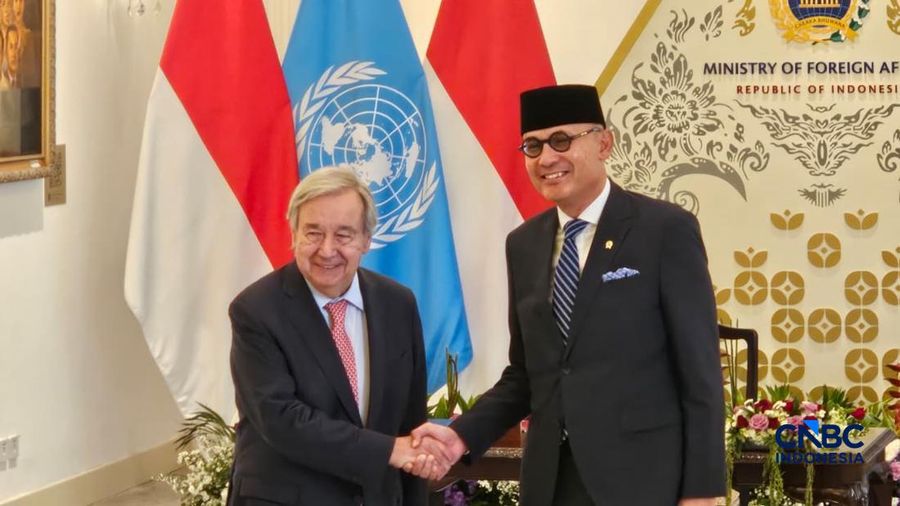

Indonesia’s cultural diversity offers a lesson in how different identities can coexist while contributing to a shared national character. That was the message highlighted by United Nations Secretary-General António Guterres during his visit to Jakarta on Monday, October 19, 2026, when he pointed to the country’s ethnic diversity, its national motto Bhinneka Tunggal Ika, and the enduring tradition of batik as examples of how cultural differences can strengthen cooperation.
Speaking at the Foreign Policy Circle Talks forum, titled Eight Decades of the United Nations: What’s Next?, Guterres described Indonesia as a country whose diversity reflects a broader vision of humanity. Indonesia’s diversity is getting recognized by the world. The event took place at the Pancasila Building, which houses Indonesia’s Ministry of Foreign Affairs.
“Indonesia is home to humanity, the world’s largest democracy, with 284 million people from more than 300 ethnic groups. Indonesia is a living example of Bhinneka Tunggal Ika,” Guterres said.
The Indonesian motto, commonly understood as “Unity in Diversity,” reflects the coexistence of different ethnic and cultural groups within one nation. Guterres suggested that Indonesia’s experience could offer valuable lessons for the international community as countries seek to strengthen cooperation despite their differences.
Batik provided another example of this cultural interaction. Guterres pointed to the traditional textile as a form of artistic expression shaped by influences from different parts of the world while remaining closely connected to Indonesian cultural identity.
Batik patterns incorporate a variety of elements, including Arabic calligraphy, Chinese motifs, and influences from Europe, Japan, South Asia, and Persia. These elements demonstrate how cultural traditions can absorb outside influences without losing their distinctive character. UNESCO has recognized Indonesian batik as an Intangible Cultural Heritage of Humanity.
“Batik is a tradition shaped by many influences, with patterns that reflect cross-cultural encounters. Yet, through these encounters, batik remains closely connected to the cultural identity of Indonesian society,” Guterres said.
For the UN chief, the significance of batik extends beyond its artistic and cultural value. He connected the way batik evolves through different influences with the need for international cooperation to adapt to a changing world.
Read also: Bali Tech Week 2026 Targets More Than 900 Business Meetings for Digital Industry Growth
“A living pattern cannot be frozen in time. New lines emerge, new colors find their place, and the design becomes richer,” he said.
The comparison reflects Guterres’s view that international institutions must evolve as global circumstances change. In particular, he emphasized the need for multilateralism to accommodate the growing role of developing countries and ensure their voices receive greater recognition in global decision-making.
This issue is closely linked to the future of the United Nations. Guterres called for reforms that would make the organization more inclusive, representative, and effective in responding to the challenges facing the international community. These include armed conflicts, climate change, economic inequality, and advances in artificial intelligence.
He also argued that the increasing influence of developing countries should be reflected in the structure of international institutions. Reforming the UN Security Council and global financial institutions was among the measures he highlighted as part of this broader effort.
The underlying concern is whether existing global institutions adequately reflect the distribution of influence in today’s world. As developing economies gain greater importance, Guterres maintained that international governance must adapt to give them a more appropriate voice. Greater representation, in this view, is essential to building institutions capable of responding to shared challenges.
Guterres’s visit to Indonesia also included meetings and activities beyond the forum in Jakarta. On Sunday, October 18, 2026, he met President Prabowo Subianto at the president’s residence in Hambalang, Bogor.
The following day, Guterres traveled to the Indonesian National Armed Forces’ Peacekeeping Mission Center in Sentul, Bogor. There, he paid tribute to Indonesian peacekeepers who had lost their lives while carrying out their duties.
The visit came as Guterres approached the end of his tenure as United Nations Secretary-General in late 2026. His engagements in Indonesia brought together several themes central to his message: respect for cultural diversity, stronger international cooperation, recognition of developing countries, and the need to reform global institutions so they can respond more effectively to contemporary challenges.
Indonesia’s experience in diversity, as reflected in its diverse population and batik tradition, served as a starting point for this wider discussion. For Guterres, the ability to bring different influences together while preserving identity offers a meaningful parallel for international cooperation. Just as cultural traditions continue to develop through new encounters, global institutions must also adapt if they are to remain relevant and representative.