




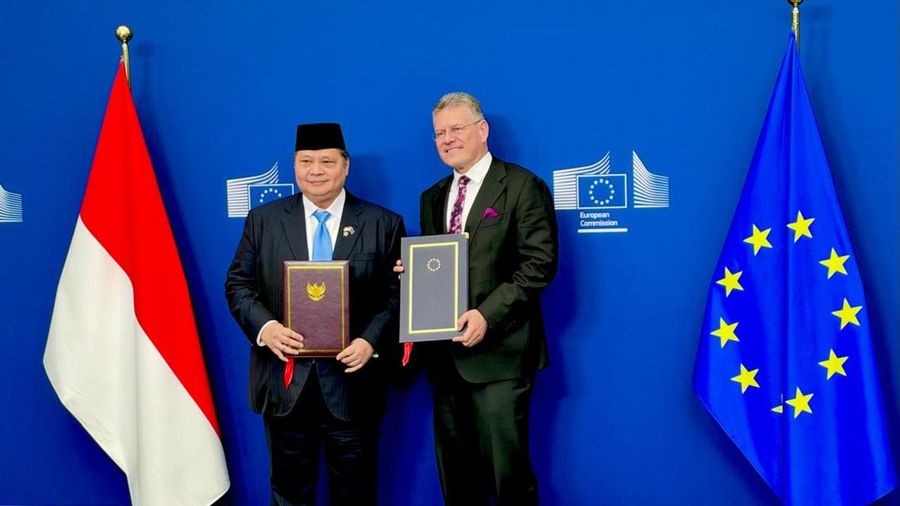

Indonesia is preparing to expand its access to the European market through a major trade agreement that could significantly change the way its products compete internationally. The Indonesia-European Union Comprehensive Economic Partnership Agreement (IEU-CEPA) is expected to remove import duties on more than 90% of goods traded between the two sides, giving Indonesian businesses greater opportunities to reach European consumers while reducing trade costs. The agreement is also expected to strengthen investment protection and deepen economic ties between Indonesia and the European Union or EU.
Coordinating Minister for Economic Affairs Airlangga Hartarto said the agreement would bring direct benefits to several domestic industries, particularly those whose products currently face relatively high import duties when entering Europe. At present, Indonesian goods entering the EU market are subject to tariffs ranging from approximately 7% to 12%. Under the IEU-CEPA, these duties will be reduced to 0%, making Indonesian products more competitive in the region.
The sectors expected to benefit include textiles, food products, footwear, garments, crude palm oil (CPO), and other agricultural commodities. With lower tariffs, Indonesian exporters could have greater opportunities to compete with suppliers from other countries and expand their presence across European markets.
“Cooperation between Indonesia and the EU, as two major economic powers in Europe and the ASEAN region, can strengthen their economies and bring benefits to the people on both sides,” Airlangga said in an official press release in Jakarta on Monday, November 23, 2026.
The agreement will also bring substantial changes to trade relations in the opposite direction. Indonesia has committed to gradually eliminating import duties on 50% of tariff lines covering vehicles imported from the EU over a five-year period. However, the arrangement will not apply to certain sensitive agricultural commodities, including rice, sugar, and ethanol, which remain excluded from the tariff reductions.
The agreement reflects the existing trade relationship between the two economic regions, where both sides exchange products across several major industries. European exports to Indonesia primarily consist of non-electrical machinery, chemicals, and agricultural products. Meanwhile, the EU imports agricultural commodities in Indonesia, mechanical and electrical equipment, and various manufactured goods, including footwear.
Beyond reducing trade barriers, the IEU-CEPA also addresses environmental standards and sustainability, particularly concerns surrounding palm oil production and deforestation. These issues have previously attracted attention in Indonesia’s trade relations with Europe, especially following the introduction of the European Union Deforestation Regulation (EUDR).
Read also: GI Tourism Indonesia Begins in Dieng, Connecting Local Products with Travel Experiences
Airlangga explained that Indonesia has maintained a deforestation moratorium policy for several years. The government has also previously submitted several concerns regarding the EUDR, leading to the EU postponing its implementation for two years.
Despite these regulatory challenges, Airlangga said Indonesia is prepared to supply products that comply with the sustainability standards agreed upon by both parties. This is particularly relevant for agricultural commodities such as palm oil, which remain important components of Indonesia’s exports to the European market.
Sustainability requirements also extend to Indonesia’s mining industry. The country has adopted Good Mining Practice standards, which require mining companies to follow responsible operational procedures. Compliance with these requirements must be incorporated into mining audits and reflected in companies’ financial reports.
According to Airlangga, these standards have been implemented for years and are already followed by international mining companies operating in Indonesia. He specifically mentioned Freeport-McMoRan and Vale as examples of companies complying with the country’s mining practices.
The IEU-CEPA is expected to officially take effect on January 1, 2027, provided that both parties complete their respective ratification processes on time. However, the timeline is particularly important for Indonesia because its preferential tariff access under the Generalised Scheme of Preferences (GSP) is scheduled to expire at the end of 2026.
The GSP currently provides Indonesian exporters with preferential access to the European market through reduced import duties. If the IEU-CEPA ratification process is delayed, Indonesian businesses could face a period in which the existing tariff benefits have expired but the new agreement has not yet entered into force.
To avoid this situation, the EU proposed holding the signing ceremony last Saturday so that the agreement could immediately proceed to the bloc’s internal approval process on Monday. The move was intended to help maintain continuity in Indonesia’s preferential trade access and prevent unnecessary disruptions for exporters.
On Indonesia’s side, the government has already conducted consultations with the House of Representatives (DPR). Airlangga explained that the ratification process can be completed through a Presidential Regulation, providing a mechanism for Indonesia to move forward with the agreement.
The scope of the IEU-CEPA also goes beyond the exchange of goods. It includes provisions designed to strengthen bilateral investment protection and provide greater legal certainty for businesses operating across both markets.
These provisions cover legal protections for investors, mechanisms for resolving disputes between the two countries, and voluntary mediation procedures involving investors and governments. The agreement also establishes a framework for future negotiations, allowing both parties to continue discussing and developing their economic cooperation.
Meanwhile, changes in United States trade policy, particularly its tariff measures, have also influenced the direction of international trade negotiations. Airlangga acknowledged that US tariff policies have affected the dynamics of global trade discussions. However, Indonesia has continued negotiating with several trading partners in parallel rather than relying on a single economic relationship.
With the reciprocal trade agreement with the United States and the IEU-CEPA with the European Union now signed, Airlangga said Indonesia is in a favorable trade position with both partners. The two agreements are expected to strengthen Indonesia’s economic relationships with major international markets while creating additional opportunities for domestic businesses.
For Indonesian exporters, the potential impact of the IEU-CEPA extends beyond lower tariffs. Greater market access, clearer investment protections, and agreed sustainability standards could help businesses establish stronger positions in Europe. At the same time, the agreement creates opportunities for European companies to expand their trade and investment activities in Indonesia.
As the January 1, 2027 implementation target approaches, the completion of the ratification process will be crucial. If both parties meet the deadline, the IEU-CEPA could mark an important development in Indonesia’s international trade relations, particularly for industries seeking to expand their reach into the European market.