


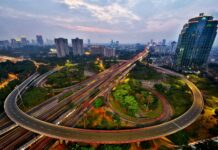



Jakarta is being prepared to take on a bigger role in the international financial industry. The Indonesian government is working on plans to establish an International Financial Centre (IFC) in the capital, drawing inspiration from the Dubai International Financial Centre. The initiative is intended to strengthen Jakarta’s position as a global city and create an environment capable of attracting international financial businesses and investment.
Coordinating Minister for Economic Affairs Airlangga Hartarto confirmed the plan during the Kearney 100 Years of Impact event in Jakarta on Wednesday, October 28, 2026. The event, themed “Jakarta Towards 500: Shaping the Next Global City Together,” brought together discussions on how the capital can develop into a more competitive global city.
Airlangga explained that the government is currently examining Dubai’s financial centre as a model for Indonesia’s own development. The initiative, officially referred to as the Indonesia International Financial Centre (PFII), will begin in Jakarta before being extended to Bali, in line with President Prabowo Subianto’s instructions.
“The central government is also pushing for an IFC. We are currently studying this model, drawing on Dubai’s financial centre. The President’s directive is to establish the first one in Jakarta, followed by Bali,” Airlangga said.
The choice of Dubai as a reference reflects the government’s effort to understand what is needed to attract international financial institutions and businesses. Airlangga said Indonesia needs to learn the expertise and requirements involved in developing a financial hub of this scale. He also considers the timing relevant, particularly as business players have expressed concerns about the situation in the Middle East.
However, establishing an international financial centre involves more than announcing an investment destination. Jakarta must also prepare the regulations, supporting institutions, infrastructure, and workforce needed to accommodate international business activities.
Airlangga said Jakarta already has a fairly strong reputation as a global city. The remaining work lies in strengthening its regulatory infrastructure, preparing the implementing regulations, and ensuring that qualified personnel are available to support the planned financial centre.
“Regulatory infrastructure is now being prepared, along with the implementing regulations and personnel readiness,” he said.
One regulatory development he specifically mentioned is the dispute settlement mechanism, which now operates under a two-tier system. Airlangga described the arrangement as sufficiently secure for international investors, using the term “water tight” to emphasize that the framework is designed to leave minimal room for gaps.
Read also: Bali Tourist Destinations Face Heavy Rain as BMKG Issues Weather Warning
“This is already water tight for international investment,” he stressed.
Transportation connectivity is another major consideration. Airlangga said an international financial centre needs an efficient transport network, allowing people to travel between important business locations within a short period. Reliable transportation and convenient connections would therefore play an important role in supporting the daily activities of international companies and financial institutions.
He praised the Jakarta Provincial Government for its progress in developing public transportation, particularly the Mass Rapid Transit (MRT) and Light Rail Transit (LRT) networks. Both projects have been designated as National Strategic Projects (PSN) under the Coordinating Ministry for Economic Affairs.
Airlangga also highlighted plans to extend the LRT network to Manggarai and strengthen transport integration in Dukuh Atas. The area is expected to accommodate two LRT terminals alongside MRT and railway services, creating a major interchange that connects several public transportation networks.
These developments are part of the wider infrastructure preparation needed to support Jakarta’s ambitions. Better connectivity could make it easier for professionals, investors, and businesses to move around the city, particularly if financial activities become increasingly concentrated in certain districts.
Still, transportation is not the only urban issue that needs attention. Airlangga pointed out that Jakarta must also address persistent challenges involving waste management and flooding. These problems remain part of the city’s broader development agenda and will need to be addressed as Jakarta prepares to strengthen its international standing.
He also emphasized the need to expand economic activities beyond traditional financial services. The services sector, digital economy, and artificial intelligence (AI) centres are among the areas that Jakarta needs to develop as part of its transformation into a global city.
The proposed IFC therefore forms part of a wider effort to strengthen Jakarta’s economic and urban capabilities. Regulatory readiness, dispute settlement mechanisms, public transportation, environmental management, digital development, and skilled human resources will all contribute to creating an environment that can support international business.
For now, the government is studying Dubai’s model while preparing Jakarta as the first location for the Indonesia International Financial Centre. Bali is expected to follow at a later stage. The initiative will require continued coordination between the central government and Jakarta’s administration, particularly in turning regulatory preparations and infrastructure plans into functioning systems that meet the needs of international investors.








 in the capital, drawing inspiration...)