




Questions about Indonesia’s future capital continue to surface. The Constitutional Court recently reaffirmed that Jakarta still officially holds the status of the nation’s capital city until a formal decision is made regarding the transfer to Nusantara, or IKN. That clarification has again raised public attention around one issue. What exactly is happening with IKN today?
Despite the ongoing legal and administrative status of Jakarta, development activities in Indonesia’s future capital are continuing. Construction and expansion efforts remain underway across parts of Penajam Paser Utara Regency and Kutai Kartanegara Regency in East Kalimantan.
But the vision for IKN appears to be growing beyond government buildings and state offices.
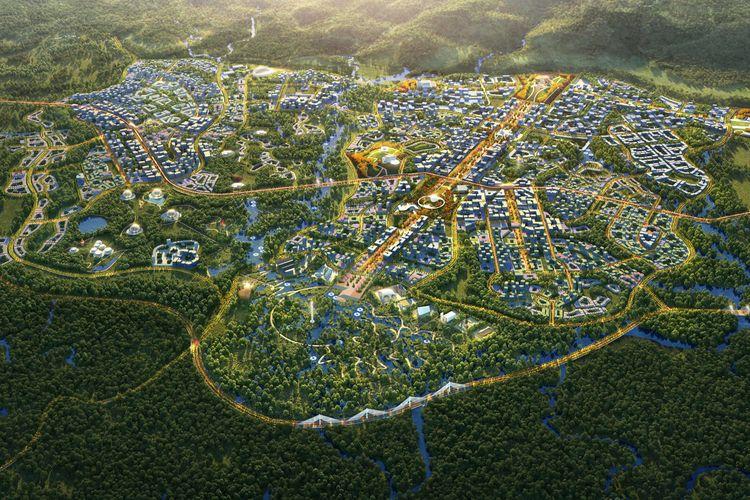
Officials say the new capital is being designed as more than an administrative center. The long-term goal is also to build a place that contributes to economic growth while creating a sustainable tourism ecosystem.
“The development of nature and cultural tourism is being carried out in Indonesia’s new capital, so it is not only projected as a state administrative city,” said Secretary of the Nusantara Capital Authority, Bimo Adi Nursanthyasto, in Sepaku, Penajam Paser Utara, on Monday, May 18, 2026.
The development strategy reflects a broader ambition for the area. IKN is not expected to function solely as the center of government operations. It is also being positioned as a future economic driver for the country.
Authorities are now shaping the area into a destination that combines modern urban development with Kalimantan’s rich natural environment and cultural identity. The approach also emphasizes environmental sustainability, preservation of local traditions, and participation from nearby communities.
The concept is intended to create benefits beyond large infrastructure projects. Tourism development is expected to generate opportunities for local businesses, especially micro, small, and medium enterprises. Service industries and transportation sectors are also expected to gain momentum as activity around IKN grows.
Read also: How Ubud Evolved From a Quiet Village Into Bali’s Global Icon
“The development of the tourism sector is one of the steps to accelerate economic growth around IKN,” Bimo explained.
Within the Central Government Core Area, known as KIPP, preparations are already underway for tourism facilities. One of the concepts being introduced is glamping areas designed for visitors who want to experience natural surroundings while still enjoying modern comfort.
The development does not stop there.
Several supporting facilities are also being prepared, including a convention center, botanical garden, culinary hubs, visitor information centers, healthcare facilities, and a Nusantara cultural center.
“That concept is part of sustainable tourism development in IKN,” he said.
Environmental tourism is also becoming part of the larger plan. The Nusantara Capital Authority is preparing a number of nature-based attractions expected to become key tourism assets in the future. The idea is to blend Kalimantan’s tropical landscape with modern facilities without losing its environmental character.
“Nature tourism areas are being prepared for environmentally friendly tourism, wellness retreats, and cultural tourism involving local communities,” Bimo added.
As the development continues, IKN appears to be taking shape as something broader than a political center. The project is moving toward a model that combines governance, economic activity, tourism, and environmental sustainability into a single vision.
For now, Jakarta remains the official capital. But in East Kalimantan, the blueprint for Indonesia’s future city continues to grow.