



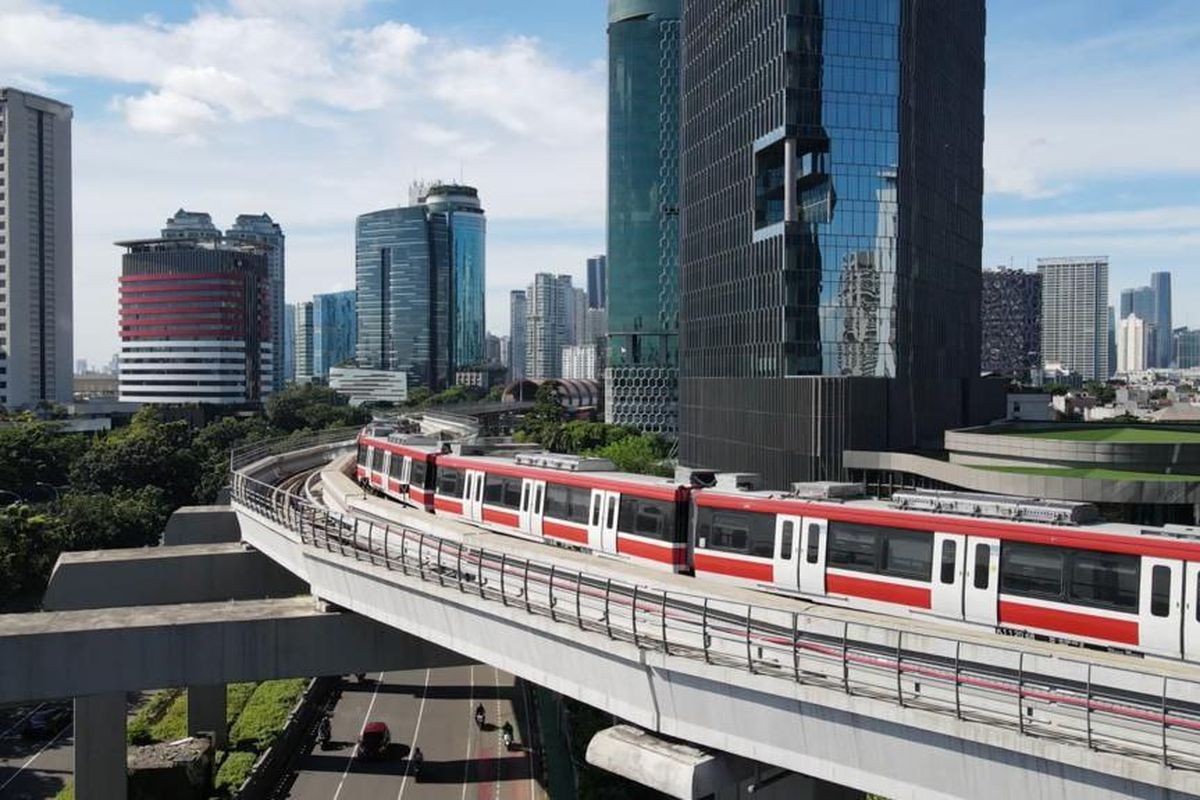

The year-end holidays told a clear story about how people moved around Greater Jakarta. During the Christmas 2025 and New Year 2026 period, LRT Jabodebek quietly proved that it is no longer just a weekday commuter option. It has become a backbone of urban mobility, even when the city slows down for a long break.
Over an 18-day period, from December 18, 2025 to January 4, 2026, LRT Jabodebek recorded 1,321,733 passengers. That figure marked an increase of around 10% compared to the previous Nataru period in 2024/2025, when ridership stood at 1,198,315 users. The jump reflects a growing shift in public travel habits, especially during peak holiday seasons.
According to LRT Jabodebek Public Relations Manager Radhitya Mardika, the rise in passenger numbers reinforces the system’s role beyond routine workday travel. It shows that LRT Jabodebek is increasingly trusted as a practical option during extended holidays, when people travel for leisure, family visits, or daily urban activities.
“During the 2025 Christmas and 2026 New Year holiday period, LRT Jabodebek users increasingly felt its benefits. Intermodal integration and easy access to various activity centers have made LRT Jabodebek a practical, safe, and well-scheduled urban mobility solution,” Radhitya said in a statement, quoted on Monday (5/1/2026).
Holiday travel patterns were clearly reflected at several key stations. Dukuh Atas Station recorded the highest passenger volume with 443,925 users. It was followed by Harjamukti Station with 305,962 users, Cikoko Station with 223,881 users, Kuningan Station with 190,401 users, and Bekasi Barat Station with 181,509 users.
Radhitya explained that these stations naturally attract heavy traffic because of their strategic locations and their role as connection points for onward journeys across the Jabodebek area. Each serves zones with varied travel needs, ranging from business districts and residential areas to leisure destinations.
Read also: Data Show Central Java Earns the Most From Tourism in Indonesia
One of the strongest drivers behind the surge was the seamless intermodal integration offered by LRT Jabodebek. The network is directly connected to multiple transportation systems, including the KRL Commuter Line, the Whoosh High-Speed Railway, the Airport Rail Link, MRT Jakarta, Transjakarta, and other transport modes. This connectivity allows passengers to switch routes efficiently and reach offices, homes, commercial centers, and public spaces without unnecessary delays.
Beyond convenience, the system also played a role in easing pressure on roads during the holiday rush. With many people choosing rail transport, reliance on private vehicles was reduced at a time when mobility demand was especially high.
“By providing integrated and sustainable services, LRT Jabodebek contributes to supporting urban mobility that is more orderly, efficient, and environmentally friendly,” Radhitya concluded.
The Nataru 2025/2026 period ultimately highlighted how urban transport habits are evolving. LRT Jabodebek is no longer seen as a secondary option. It is increasingly becoming a first choice, even when the city is in holiday mode.