




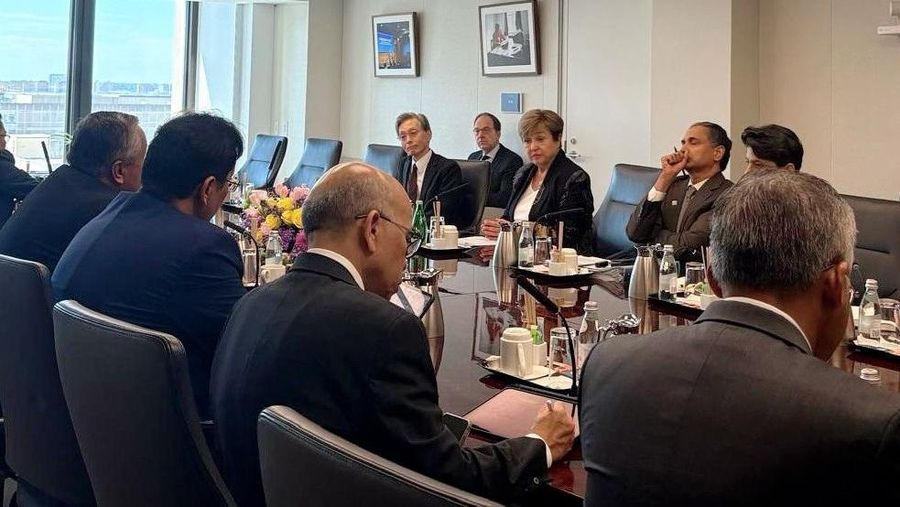

Amid growing uncertainty across the global economy, one country continues to stand out. Indonesia is once again being seen as a source of stability and optimism on the world stage. That view gained attention during the IMF Spring Meetings 2026, held in the United States from April 13 to 18, 2026. In a series of discussions with global investors, Indonesia was highlighted as one of the “bright spots” in the current economic landscape.
The statement came from Kristalina Georgieva, Managing Director of the International Monetary Fund, during a meeting with Perry Warjiyo, Purbaya Yudhi Sadewa, and members of Indonesia’s House of Representatives on April 14.
According to Bank Indonesia, the recognition is not without reason. Its strong economic fundamentals, credible policy direction, and consistent resilience have placed Indonesia in a favorable position for one of the bright spots, even as global uncertainty continues to rise.
“IMF and global investors appreciate Indonesia’s consistency in maintaining macroeconomic stability through solid fiscal and monetary policy synergy, discipline in keeping the deficit below 3% of GDP, and adaptive, forward-looking policy responses in addressing external pressures,” said Anton Pitono, Head of the Communication Department at Bank Indonesia, in an official statement on April 15, 2026.
He noted that Indonesia has managed to maintain a careful balance. Stability is preserved, yet growth continues. Strong domestic demand remains a key driver behind this momentum.
The government and Bank Indonesia are aware that the situation is far from simple. Global conditions are becoming more complex. Still, both institutions are committed to keeping the national economy on a stable and well-managed path.
“With solid economic growth supported by strong domestic demand, inflation kept within target, and the recovery of banking intermediation, Indonesia continues to demonstrate resilience amid external pressures,” Anton explained.
Read also: Cenderawasih Bay Earns Spot on Time 50 Best Places to Visit 2026
Policy strategy has also evolved. The approach is no longer limited to conventional tools. Instead, Bank Indonesia now applies a more integrated and adaptive mix. This includes monetary policy focused on stability, macroprudential measures that support growth, and stronger payment systems to accelerate economic activity and digital transformation.
“Amid increasingly complex global dynamics, Bank Indonesia reaffirms its commitment to maintaining stability through flexible yet measured exchange rate management, strengthening monetary instruments to maintain the attractiveness of domestic assets, and prudent liquidity management to support growth,” he added.
Coordination with the government plays a crucial role in this effort. Fiscal discipline remains a priority, including the commitment to keep the deficit below 3% of GDP. At the same time, spending is being redirected toward more productive sectors. These steps help strengthen Indonesia’s credibility in the eyes of global investors, who were also present during the meetings.
Looking ahead, Indonesia is not only focused on short-term stability. There is also a clear direction for long-term transformation. The country aims to move toward a higher value-added economy through downstream industrialization and the expansion of technology-based sectors.
“In the medium term, Indonesia also reaffirms its direction toward structural transformation into a higher value-added economy through downstream industrialization and the development of technology-based sectors,” Anton stated.
By the end of the meetings, one message became clear. Investor confidence in Indonesia is not just holding steady. It is growing stronger. The country is seen as not only resilient, but also increasingly adaptive and credible in maintaining stability while pushing for sustainable economic growth.