




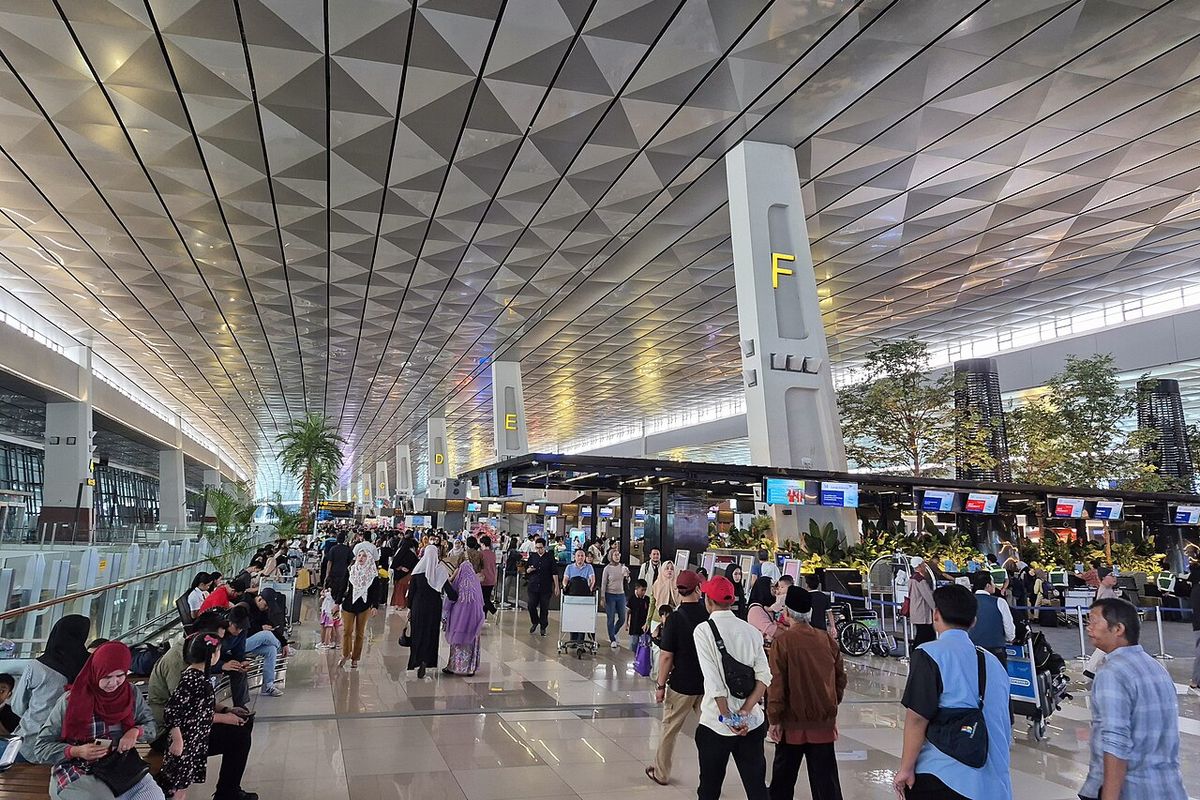

Soekarno-Hatta International Airport has moved ahead of Kuala Lumpur International Airport (KLIA) in one of Southeast Asia’s key aviation rankings. The airport in Tangerang, Banten, was named the region’s second busiest airport in July 2026 based on scheduled airline seat capacity. The latest figures show that Jakarta’s main international gateway is gaining ground while KLIA recorded a year-on-year decline.
Data from travel data provider Official Airline Guide (OAG) showed that Soekarno-Hatta had a scheduled capacity of 3.32 million seats in July 2026. That placed it just behind Singapore Changi Airport, which remained Southeast Asia’s busiest with 3.56 million seats.
“Jakarta, Indonesia, became the second busiest airport with a capacity of 3.3 million seats, an increase of 3.2 percent compared with July 2025,” OAG wrote.
The latest figure represents a 3.2 percent increase from July 2025, when Soekarno-Hatta recorded 3.22 million scheduled seats.
KLIA, meanwhile, moved down to third place. Its scheduled capacity stood at 3.15 million seats in July 2026, down 4.4 percent from 3.30 million seats a year earlier.
The change is notable because the two airports had a very different position in the ranking just one year earlier. In July 2025, KLIA had around 80,000 more seats than Soekarno-Hatta. By July 2026, Soekarno-Hatta had reversed the gap and held an advantage of roughly 170,000 seats over the Malaysian airport.
Singapore Changi continued to lead the region. Its 3.56 million seats represented modest growth of 0.1 percent compared with July 2025.
The ranking continued with Bangkok’s Suvarnabhumi Airport in fourth place. It recorded 3.14 million seats during the month. Manila’s Ninoy Aquino International Airport followed in fifth with 2.58 million seats.
OAG compiled the ranking using scheduled airline seat capacity for July 2026 and compared the figures with the same month in 2025. The data comes from OAG’s scheduled capacity database and uses a year-on-year comparison based on the same calendar month.
Read also: Mount Bromo Restricts Tourist Access as Forest Fire Response Continues
The shift in the regional ranking comes as Malaysia’s aviation sector goes through a period of adjustment.
Malaysia Airports’ airport network recorded 7.6 million passenger movements throughout June 2026. International travel accounted for 4.1 million of those movements, while domestic travel contributed another 3.5 million, according to The Star.
Passenger traffic slowed compared with the previous month. Several airlines responded by optimizing their flight networks and aircraft utilization.
Higher fuel prices were among the factors affecting these decisions. Airlines were also responding to changes in travel demand and ongoing geopolitical uncertainty, according to Migrant Times.
Domestic travel has felt the impact as well. Sabah recorded a 7.1 percent decline in passenger movements during the first half of 2026.
Other Malaysian destinations also experienced weaker domestic traffic. Penang and Langkawi saw declines, as did several secondary airports across the country compared with the same period a year earlier.
International demand, however, continues to provide support for Malaysia’s aviation market. Travel connections involving Indonesia, Singapore, Thailand, China, Australia, Vietnam, and Europe remain among the markets helping sustain passenger demand.
The latest OAG figures therefore highlight a changing aviation landscape in Southeast Asia. Soekarno-Hatta’s rise to second place comes alongside stronger scheduled capacity, while KLIA faces a decline in available seats. At the same time, Changi continues to hold the top position, keeping competition among the region’s major aviation hubs firmly in focus.









 in one of Southeast Asia's key aviation...)