




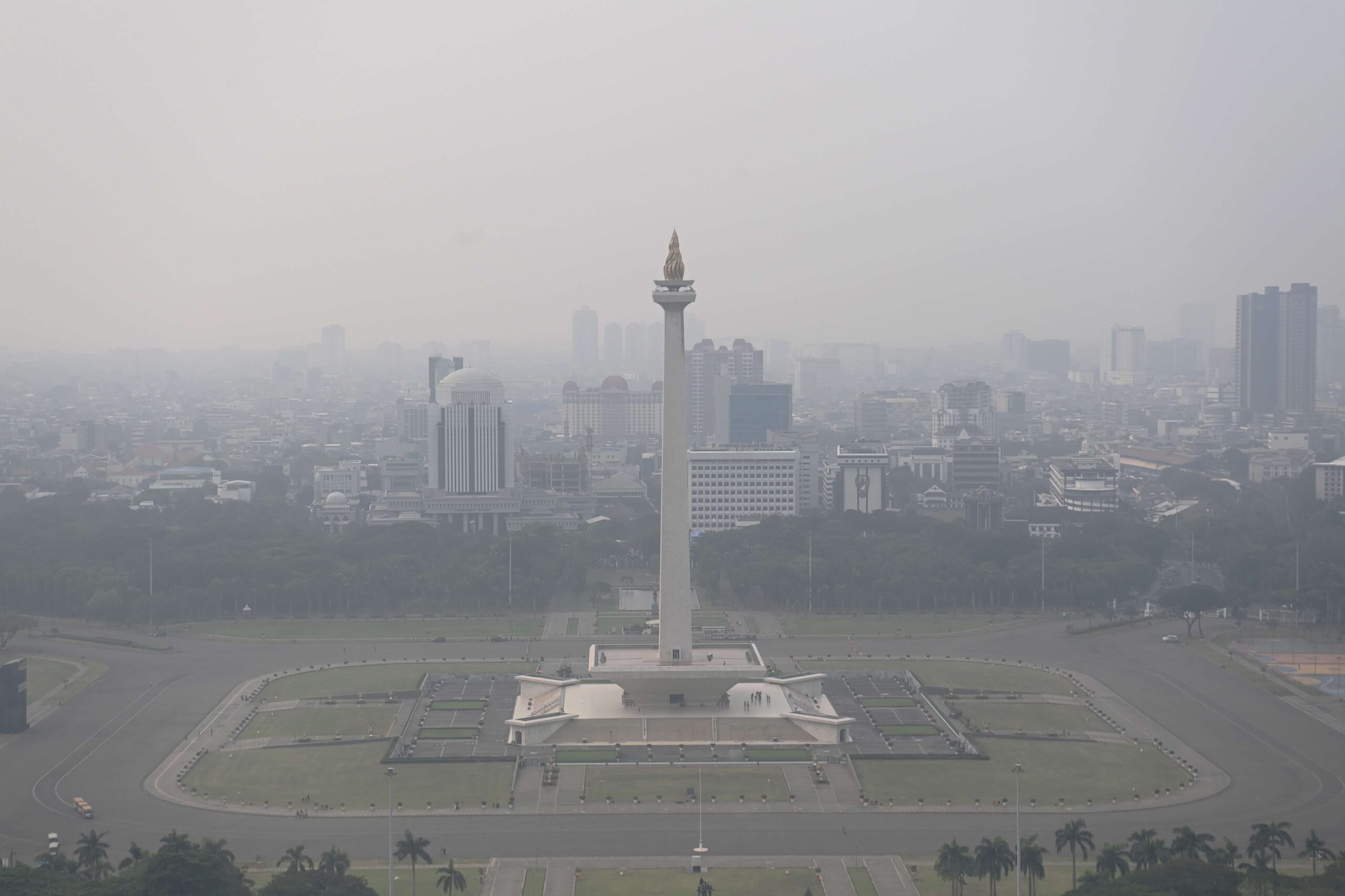

Air pollution in Jakarta is no longer viewed as just an environmental issue. Authorities warn it may directly affect how long residents live, especially due to exposure to fine particulate matter known as PM2.5.
The Jakarta Environmental Agency (DLH) says this form of pollution carries serious health risks. Vulnerable groups such as toddlers and the elderly are considered the most at risk. According to officials, numerous academic studies and medical findings have already confirmed the harmful effects of polluted air on human health.
Head of the Pollution and Environmental Damage Control Division at DLH Jakarta, Erni Pelita Fitratunnisa, explained that PM2.5 particles contain extremely small toxic components that can easily enter the human body.
“PM2.5 is a particle that actually contains many extremely tiny sub-particles, and they are toxic. When they enter the body, one of the main pathways is through breathing. They then reach the lungs,” Fitri explained during a discussion on air pollution with the Ministry of Environment and Forestry and Clean Air Asia in the Menteng area of Central Jakarta on Wednesday (4/3).
Health data also indicate that rising air pollution levels are linked to increasing cases of respiratory illness in the capital.
“Friends from the Ministry of Health have also conveyed the same thing. The trend is respiratory infections, especially among vulnerable age groups. Vulnerable groups include toddlers and the elderly,” she said.
Read also: Bali Grants Emergency Stay Permits to Foreign Tourists Stranded by Middle East Conflict
To track pollution levels more closely, DLH Jakarta has installed Air Quality Monitoring Stations known as SPKU. These monitoring systems are connected to two public applications, JAKI and Udara Jakarta. The system is designed to alert residents when PM2.5 concentrations exceed safe limits.
“There is a kind of warning. When PM2.5 levels exceed the quality standard, the public is expected to take certain actions. But if conditions are still considered safe, there are also recommendations on what people should do,” Fitri said.
Despite these monitoring tools, public awareness about the health impact of air pollution remains a challenge. Fitri recalled an incident involving a school where officials asked teachers to limit outdoor activities because of dangerous pollution levels.
“There was a teacher we informed, saying, ‘Sir, Ma’am, the air quality measurement here shows PM2.5 has exceeded the standard. This affects the health of school children. Outdoor activities outside the classroom should be reduced.’ But they became upset and did not respond well,” Fitri explained.
Further investigation revealed that vehicle emissions in the area were a key contributor to the high readings.
“Why was the PM2.5 level high? Because many motorcycles were parked there. When people start their motorcycles and rev the engines, the PM2.5 emissions are detected by our monitoring station,” she added.
According to Fitri, the long-term risks of PM2.5 exposure go beyond respiratory illness. Continuous exposure may also shorten the life expectancy of Jakarta residents.
“Even more concerning, research from IPB has indicated that some cases of autism in children are also linked to or influenced by exposure to air pollution,” she said.
Motor vehicles remain one of the main contributors to air pollution in the city. However, DLH notes that other activities also play a role. One of them is the burning of waste in open spaces.
“Especially if trash burning is carried out in an uncontrolled manner. The penalty is Rp 500,000, but when there is smoke we often do not know who burned it,” she said.
Officials believe that addressing Jakarta’s air pollution problem will require sustained efforts and cooperation from the public. The challenge could become even greater as the dry season approaches, a time when pollutant concentrations in the city’s air tend to increase.