




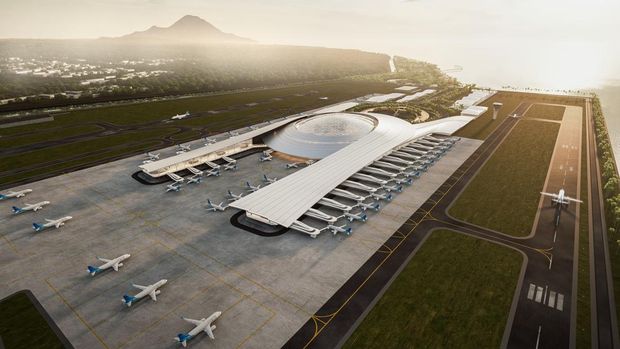

Bali could soon have a second international airport capable of handling some of the world’s largest passenger aircraft. After years of discussion, plans for the North Bali Airport in Kubutambahan, Buleleng, are once again moving forward, with the government now pushing for faster implementation.
The planned airport is not intended to serve only narrow-body aircraft commonly used on regional routes. From the beginning, its infrastructure has been designed to accommodate wide-body aircraft, including the Boeing 777 and Airbus A380. This would allow Bali to strengthen its capacity for long-haul international flights and prepare for future growth in air traffic.
The latest push for the project followed a meeting between President Prabowo Subianto and Baringin Panggabean, President Commissioner of PT Pembangunan Bali Mandiri (PEMBARI), at the President’s residence in Hambalang, West Java, on July 14, 2026. Minister of State Secretary Prasetyo Hadi also attended the meeting.
During the meeting, Baringin provided an update on the New Bali Airport project. The project has already been included as one of the National Priority Projects under the 2025–2029 National Medium-Term Development Plan (RPJMN), based on Presidential Regulation No. 12 of 2025.
One of the main issues discussed was whether the airport’s infrastructure would be ready to support large international aircraft. Prabowo specifically highlighted the importance of the runway and supporting facilities, particularly their ability to accommodate long-haul international flights using wide-body aircraft.
According to Baringin, this requirement has been considered since the airport was first planned. The proposed North Bali Airport has been designed according to international standards, with its runway, airside infrastructure, and other supporting facilities prepared for aircraft such as the Boeing 777 and Airbus A380.
The technical plans are based on a feasibility study that has received approval from the Directorate General of Civil Aviation under the Ministry of Transportation.
The government is also seeking to move beyond the planning stage more quickly. During the meeting, Prabowo called for the construction process to be accelerated, with a target of completing the project in approximately three years. The aim is to ensure that the airport’s potential benefits can reach the public without unnecessary delays.
Financing will be handled through a Public-Private Partnership scheme, known in Indonesia as Kerja Sama Pemerintah dengan Badan Usaha (KPBU). Rather than relying on the State Budget (APBN), the project will be funded through private investment. This approach is intended to prevent the airport from placing a direct burden on the state budget while giving private-sector players an opportunity to participate in the development of strategic infrastructure.
The planned airport is also part of a broader strategy to reorganize aviation functions in North Bali. The government is preparing a system in which two aviation facilities in Buleleng Regency will serve different purposes.
Under Bali Provincial Regulation No. 2 of 2023, the North Bali Airport will operate as a public airport serving commercial flights. Its facilities will include the capacity to handle wide-body aircraft. Letkol Wisnu Airfield, meanwhile, is planned to operate as a special airport for smaller aircraft and private jets.
This division of functions was discussed again during a coordination meeting at the Coordinating Ministry for Infrastructure and Regional Development on July 30, 2026. The government reaffirmed that Letkol Wisnu Airfield should focus on small-scale aviation rather than being developed into another large international airport.
There are several reasons behind that approach.
Read also: Bali Helicopter Tours Start From IDR 1.99 Million in 2026
The area surrounding Letkol Wisnu Airfield has already become densely populated, with residential settlements surrounding the facility. Its geographical conditions also create additional limitations. Hills surround the area on its southern, western, and eastern sides, while the northern side directly faces a mangrove area and the sea.
The area’s cultural landscape presents another consideration. Several hilltops around the airfield are home to sacred temples that have existed for hundreds of years, with some believed to date back even thousands of years. Expanding the Letkol Wisnu area into a large-capacity international airport would therefore face both geographical and cultural constraints.
For the government, these conditions strengthen the case for building a separate airport in Kubutambahan. Instead of forcing Letkol Wisnu to handle large-scale international aviation, the New Bali Airport would provide the additional capacity Bali needs while allowing the existing airfield to retain a more specialized role.
The plan received another push from Prabowo on July 20, 2026, when he addressed a Plenary Cabinet Meeting at the State Palace. During the meeting, the President instructed ministries and government agencies to accelerate the implementation of national strategic projects. The North Bali Airport was among the projects highlighted, having already been included in the 2025–2029 RPJMN.
If the plans move ahead as intended, North Bali will eventually have two aviation facilities with clearly different roles. Letkol Wisnu Airfield would cater to small aircraft and private jets, while the New Bali Airport in Kubutambahan would handle commercial international flights, including wide-body aircraft such as the Boeing 777 and Airbus A380.
The impact of the project could extend far beyond aviation.
A second international airport in Bali is expected to improve air connectivity and support a more even distribution of economic activity across the island. The development could create new economic growth centers, attract additional investment, generate employment, and support the expansion of tourism, trade, logistics, and service industries.
The potential effects would not be limited to Kubutambahan or Buleleng. The project is expected to contribute to economic development across North Bali, while also creating stronger links with areas in West Bali and East Bali.
For an island whose economy and tourism sector depend heavily on international connectivity, the development of a new airport could therefore represent a major shift in how future aviation demand is managed. With the North Bali Airport designed from the outset for large international aircraft, the project is being positioned not simply as an additional airport, but as part of Bali’s longer-term infrastructure strategy.
If the construction target of approximately three years is achieved, Bali could eventually have a second international gateway capable of handling aircraft far larger than those typically associated with regional aviation. At the same time, the continued role of Letkol Wisnu would provide a separate facility for smaller aircraft and private aviation.
Together, the two facilities are planned to create a complementary aviation network for North Bali, while supporting the island’s wider ambitions for connectivity, investment, tourism, logistics, and economic growth.