



Kebun Raya Bogor has long been known as a place to slow down. Trees, flowers, fresh air. A pause from the city. But behind that calm surface, another story quietly survives. One that many visitors walk past without realizing what lies beneath their feet.
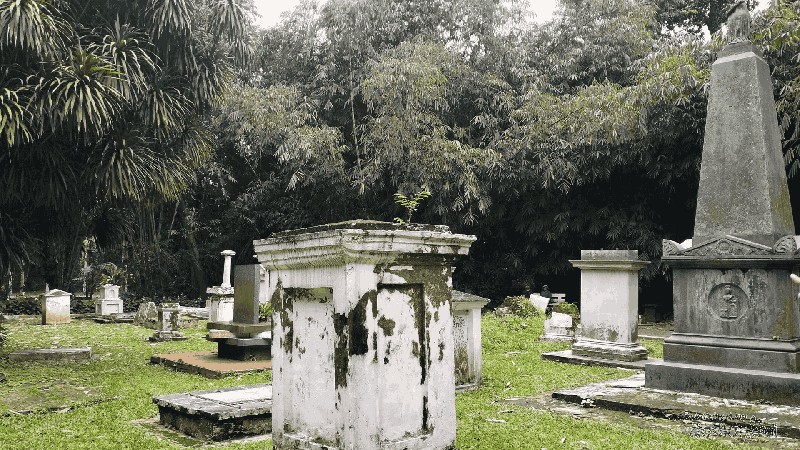
Tucked inside the vast grounds of Kebun Raya Bogor are old Dutch graves from the colonial era. They are silent, weathered, and heavy with history. Some still stand intact. Others show clear signs of time and nature taking their toll.
According to DetikTravel, a tour guide from Jakarta Good Guide named Ara explained that nearly all the graves in this area belong to Dutch individuals. Over the years, several tombstones have been damaged by natural causes. Fallen trees are one of the main reasons. One grave, in particular, is badly broken, its condition reflecting both age and environmental pressure on this historic site.
Among all the graves, one draws immediate attention. The largest tombstone in the area belongs to a man named Aprins. Its size alone sets it apart. The symbols carved into it make it even more striking.
Aprins once served as an acting governor during the Dutch East Indies period. At the time, when the position of governor was vacant, an acting official would be appointed for about six months. Historical records show that Aprins held this role twice.
“Aprins was an acting governor during the government era. In the past, when there was an election for a new governor-general, there was a six-month vacuum period, usually filled by two acting governors,” said Ara.
Beyond that role, Aprins also held a high-ranking judicial position. He served as Vice President of Raad van Nederlandsch-Indië, or the deputy head of the highest court in the Dutch East Indies. He passed away in 1867 and was buried in Kebun Raya Bogor. His grave remains identifiable to this day.
What makes the tomb even more intriguing are the symbols engraved on it. A star. A snake biting its own body. An inverted torch. According to the guide, these markings suggest that Aprins was a member of the Freemasons.
Ara clarified that the primary symbol of Freemasonry is actually the compass and the square, not the many symbols often linked to secret societies. Freemasonry itself began in Europe as a guild of stone masons and carpenters.
Its role changed significantly over time. In Indonesia, Freemasonry attracted elites. Many members were wealthy, influential, and deeply interested in science, art, and philanthropy.
“In Indonesia, the requirements are that you have to be rich and an entrepreneur,” said Ara.
Read also: Yogyakarta Overtakes Bali as Top Family Holiday Destination for Year End 2025
Even today, the compass and square symbol is still used by organizations considered to have similar historical roots, such as Rotary Club. Freemasonry teachings also include the symbol of an eye, representing the belief that human actions are always observed by God.
This symbol is often misunderstood. It is different from the “one eye” concept commonly associated with Illuminati. The Freemason organization itself is structured in levels, with the highest position known as the Grand Master.
Joining the group was never simple. Candidates had to go through interviews and strict selection processes. Background checks and social status mattered.
In Indonesia, several prominent figures were recorded as Freemason members. Among them were Raden Saleh, Dr. Rajiman Wedyodiningrat, Raden Said Sukanto, the first Chief of Police of the Republic of Indonesia, Sri Sultan Hamengkubuwono VIII, Sri Paduka Paku Alam VII, and aristocratic families such as Tumenggung Sumitro Kolopaking.
These names reflect the reality of Freemasonry at the time. It was dominated by nobility and elite circles with strong political and social influence.
The presence of Dutch graves in Kebun Raya Bogor is more than a reminder of colonial rule. It opens a window into power structures, elitism, and social networks that once shaped the Dutch East Indies. For visitors willing to look beyond the gardens and trees, the past is still there. Quiet. Waiting to be noticed.