




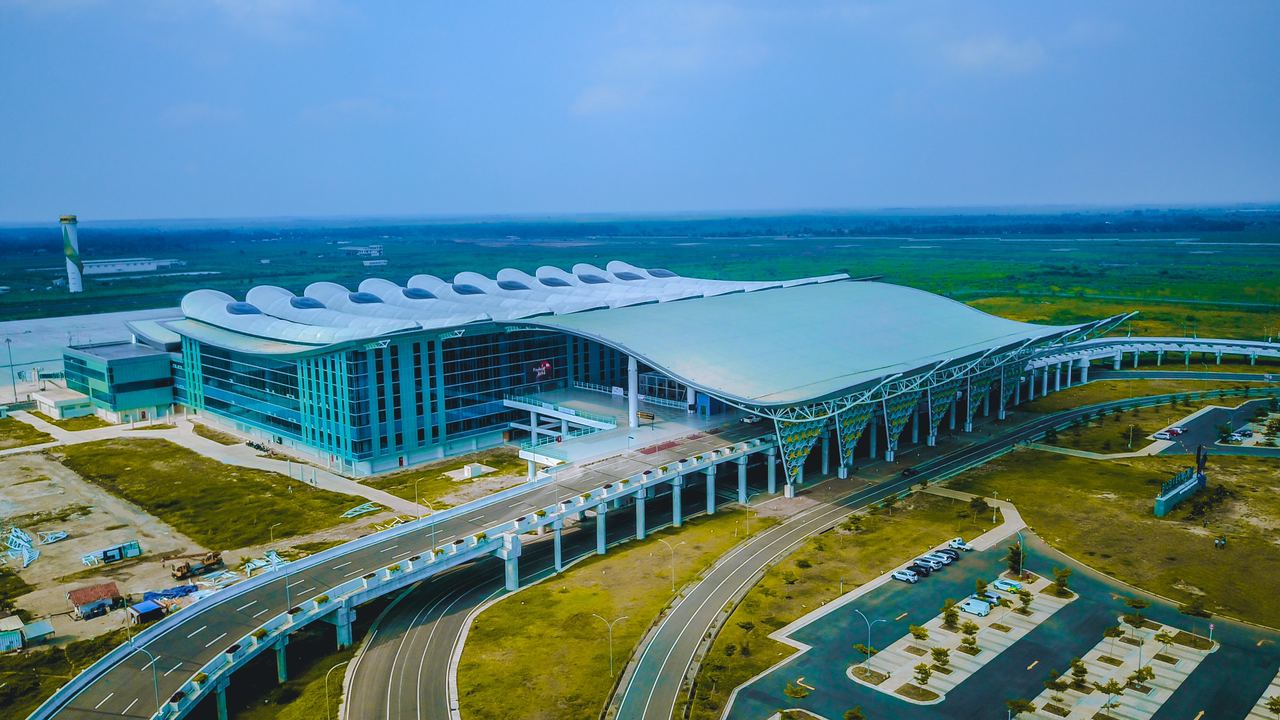

Standing tall in Majalengka, West Java International Airport (BIJB) Kertajati was built to impress. With its grand architecture, long runway, and world-class facilities, it was envisioned as a new aviation hub for the region. Yet, despite its magnificence, one question continues to echo: why does Kertajati Airport remain so quiet?
That same question was raised by Coordinating Minister for Infrastructure and Regional Development Agus Harimurti Yudhoyono (AHY) during a media gathering in Central Jakarta on Tuesday (October 21, 2025). “Who has ever been there? What’s Kertajati like? Quiet? But it’s nice, right? Big, beautiful, majestic, but in the middle of nowhere—in Majalengka, in the Rebana area (Cirebon, Patimban, Kertajati),” said AHY.
Spanning 1,800 hectares with a 121,000-square-meter passenger terminal and a 3,000-meter runway, Kertajati Airport was designed to serve up to 29 million passengers annually by 2032. On paper, its potential looks promising. Yet, its reality tells a different story.
The airport’s biggest challenge lies in connectivity. Located about 68 kilometers from Bandung and far from major population centers, it struggles to attract passengers due to limited access. “The airport was built, but the connectivity came late, so it became half-hearted. People thought, ‘Ah, might as well go to Jakarta instead,’ so it was left behind and quiet,” AHY explained.
In its early years, road access to the airport was still incomplete, with few public transport options available. This situation led many West Java residents—especially those in Bandung—to favor Soekarno-Hatta Airport in Tangerang, which was far easier to reach.
Kertajati finally began full operations on October 30, 2023, after all flights from Bandung’s Husein Sastranegara Airport were transferred there. However, the move didn’t instantly draw crowds. For many travelers, Husein remained the more practical choice due to its city-center location, while Kertajati required an extra two-hour trip from Bandung.
Read also: Indonesia Explores NTN-D2D Technology to Boost Nationwide Connectivity
Then-Minister of Transportation Budi Karya Sumadi said the relocation was made for safety reasons and to boost air traffic capacity. Technically, the decision was sound, but for passengers, comfort and travel time were still major concerns.
Recognizing this, AHY assured that the government would not let Kertajati remain underutilized. He revealed a concrete plan to transform the airport area into a Maintenance, Repair, and Overhaul (MRO) hub for aircraft and helicopters, also known as an Aerospace Park. “We’re trying to bring it to life by establishing cooperation between BIJB management and GMF (Garuda Maintenance Facility),” AHY said.
The initiative aims to attract the aviation industry and generate new economic activity around the airport. If successful, Kertajati could finally evolve into a vibrant hub—no longer a grand but empty terminal, but a thriving center that fuels regional growth.