

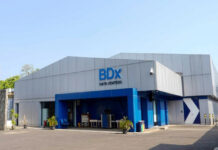



A quiet but decisive shift is underway at Indonesia’s busiest port. At Tanjung Priok in Jakarta, the government has begun rolling out new technology that reshapes how goods are monitored, analyzed, and secured as they move in and out of the country. On Friday (12/12/2025), the Ministry of Finance, through the Directorate General of Customs and Excise, officially launched an X-ray container scanner equipped with a radiation portal monitor feature. The launch marks a concrete step toward a more modern customs system.
The new scanner allows officers to inspect containers quickly and accurately. There is no need to open them physically. More importantly, the radiation portal monitor can detect nuclear materials and radioactive substances hidden inside cargo. This capability strengthens national security while keeping logistics flows efficient.
During the same event, Customs also unveiled two digital innovations currently under development. The first is Self Service Report Mobile, known as SSR-Mobile. The second is Trade AI. Both are designed to support the broader digital transformation of Indonesia’s customs services.
The government views container scanning technology and artificial intelligence as strategic tools. They help improve transparency. They secure the movement of goods. They also reinforce Indonesia’s economic competitiveness. Digital systems, officials believe, play a key role in maintaining public trust in customs administration.
Read also: Goa Cemara Beach Prepares All-Day New Year Festival to Welcome 2026
“We must maintain public trust and economic competitiveness. In addition, smuggling must be fought with more modern approaches,” said Minister of Finance Purbaya Yudhi Sadewa.
Beyond security, the new scanner is expected to speed up services at the port. Faster inspections mean smoother import and export processes. At the same time, oversight becomes more effective. The technology is expected to help prevent customs violations that could harm the national economy.
Attention then turned to SSR-Mobile. This feature is part of the CEISA 4.0 Mobile application. It allows companies to submit reports independently using a digital platform. The system is equipped with geotagging, real-time recording, and artificial intelligence support.
SSR-Mobile is designed to monitor the movement of goods within customs facility areas. These include Bonded Zones, KITE facilities, Free Trade Zones, and Special Economic Zones. Through the application, companies can handle gate-in procedures, stuffing, unloading, and gate-out processes on their own. While these activities take place, the AI system automatically conducts risk analysis in the background.
“With this transformation, bureaucracy can be streamlined, compliance increases, and opportunities for fraud are further closed,” said Purbaya.
Customs is also developing Trade AI as another layer of oversight. This artificial intelligence system focuses on improving the accuracy of import analysis. Its main task is early detection. The system is designed to identify under-invoicing, over-invoicing, and potential trade-based money laundering.
Trade AI works by analyzing customs values, classifying goods, and verifying documents. In the future, it will be fully integrated with the CEISA 4.0 system. This integration is expected to strengthen coordination across units and support faster, more informed supervisory decisions.
“This system will make supervision sharper and decision-making faster,” Purbaya emphasized.
According to the minister, the combined implementation of the X-ray container scanner, SSR-Mobile, and Trade AI represents a major milestone. Customs supervision is moving toward a model that is adaptive and driven by data. These tools also prepare authorities to confront increasingly complex patterns of international trade crime.
“At the same time, services to the public and the business community must become faster, simpler, and more integrity-driven. That is the mandate we must carry out,” he concluded.
Taken together, these initiatives signal a new chapter for Indonesia’s Customs and Excise. The digital transformation reflects a broader government commitment to delivering customs services that are modern, efficient, and responsive to global challenges.