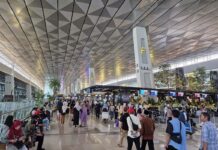
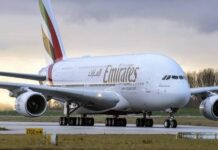


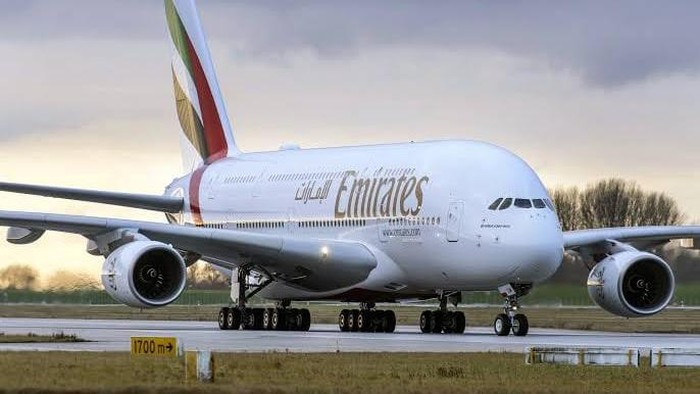

For the first time, an Airbus A380-800 operated by Emirates has touched down at Soekarno-Hatta International Airport. The arrival marks a new milestone for Jakarta’s main international gateway and Indonesia’s global air connectivity.
The aircraft arrived on Saturday night, August 8, 2026, on Emirates flight EK358 from Dubai (DXB) to Jakarta (CGK). It landed at Soekarno-Hatta International Airport (Soetta) in Tangerang, Banten, at 10:25 p.m. local time.
Around 600 passengers were on board.
The A380 did not stay long in Jakarta. It departed for Dubai at 12:45 a.m. on Sunday, August 9.
For Soekarno-Hatta, however, the arrival was more than a regular flight operation. Airport management described it as an important moment that demonstrates the airport’s ability to handle one of the world’s largest commercial aircraft.
“The arrival of Emirates’ Airbus A380-800 marks an important milestone for Soekarno-Hatta International Airport. We have ensured that every operational aspect, from airside and landside infrastructure readiness and service procedures to coordination with regulators, AirNav Indonesia, ground handling, and all relevant stakeholders, has been properly prepared,” said Heru Karyadi, General Manager of Soekarno-Hatta International Airport, as quoted by Antara on Sunday, August 9, 2026.
The arrival also strengthens Indonesia’s international aviation connectivity. At the same time, it confirms that Soekarno-Hatta is ready to serve aircraft classified under ICAO Aerodrome Reference Code 4F, also known as Code F.
This category includes large aircraft such as the Airbus A380.
Read also: Australian National Deported From Bali Over Alleged Visa Misuse
“It also reflects the confidence of international airlines in the quality of Soekarno-Hatta International Airport’s infrastructure and services,” Heru said.
Soekarno-Hatta Is Ready for the A380
The Airbus A380-800 is the world’s largest commercial aircraft. It features a full double-deck configuration, allowing it to carry a large number of passengers.
The aircraft measures 72.7 meters in length. Its wingspan reaches 79.75 meters.
Handling an aircraft of this size requires substantial airport infrastructure. Soekarno-Hatta is Indonesia’s largest and busiest airport and operates three runways to support its flight activities.
Two of its runways meet the requirements for ICAO Aerodrome Reference Code F aircraft.
One runway measures 3,660 meters by 60 meters. The other measures 3,600 meters by 60 meters. Both are capable of supporting aircraft such as the Emirates Airbus A380.
But runways aren’t the only consideration.
The airport is also equipped with parallel taxiways, aprons, and various terminal facilities designed to support wide-body aircraft operations.
“This infrastructure is supported by a network of parallel taxiways, aprons, and various terminal facilities that have been prepared to support wide-body aircraft operations, including the Airbus A380-800,” Heru said.
These facilities are important because an aircraft as large as the A380 requires careful coordination across several parts of the airport. Aircraft movement, passenger handling, baggage operations, and ground services all have to work together.
The A380’s first landing at Soekarno-Hatta was not something that happened overnight.
Before the aircraft arrived, airport authorities and multiple agencies carried out a series of preparations. Soekarno-Hatta worked closely with Emirates, the Directorate General of Civil Aviation, AirNav Indonesia, ground handling providers, Immigration, Customs, Quarantine, and other relevant stakeholders.
The teams conducted coordination meetings, verification procedures, and operational simulations.
The goal was straightforward. Every stage of the operation needed to run safely and efficiently.
That included the aircraft’s arrival, passenger handling, baggage handling, and its eventual departure back to Dubai.
Specialized Ground Support Equipment, or GSE, was also prepared for the A380.
The equipment included an aircraft towing tractor specifically designed for the Airbus A380-800. Other equipment included high-lift loaders, belt conveyor loaders, container dollies, and pallet dollies.
“Operational readiness was also supported by specialized Ground Support Equipment (GSE), including an aircraft towing tractor for the Airbus A380-800, high-lift loader, belt conveyor loader, container dollies, and pallet dollies, so that all aircraft handling processes can operate optimally,” Heru explained.
The successful arrival of Emirates’ A380 therefore represents more than the landing of a larger aircraft. It shows that Soekarno-Hatta has prepared the infrastructure, equipment, procedures, and coordination needed to accommodate one of the aviation industry’s biggest passenger aircraft.
For Indonesia, the milestone also adds another layer to its international connectivity. With Soekarno-Hatta now demonstrating its readiness to handle the Airbus A380-800, the airport has further strengthened its position as a major gateway for international air travel.