




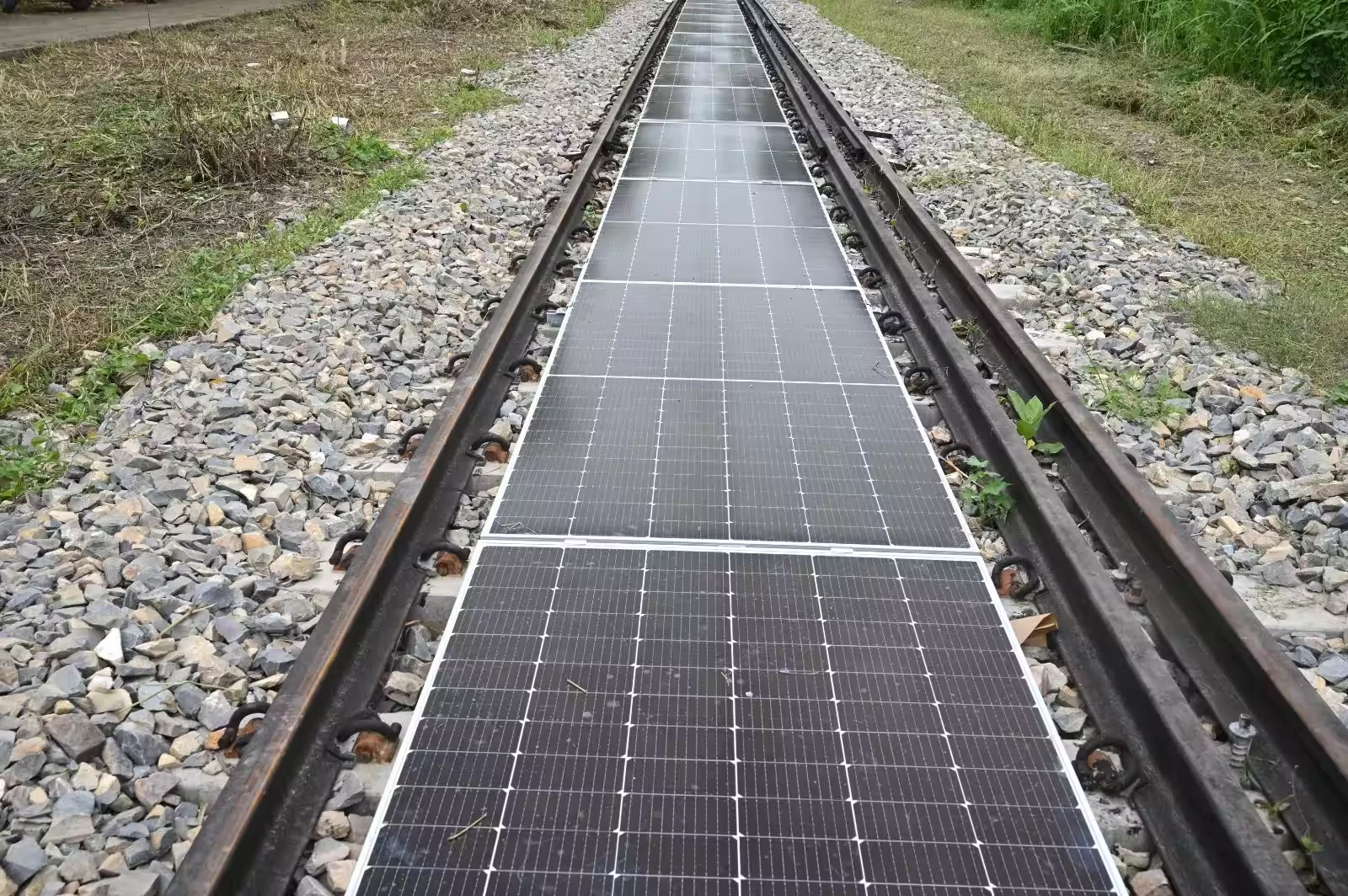

Indonesia is exploring an unconventional way to expand its solar energy capacity without relying entirely on new land acquisitions. The government is studying the possibility of installing solar panels along the railway network operated by Kereta Api Indonesia (KAI), which could potentially generate up to 5.4 gigawatts (GW) of electricity. If implemented, the initiative could help address one of the biggest obstacles facing large-scale solar power development in the country: the limited availability of affordable land, particularly on Java Island.
The proposal was revealed by Presidential Special Envoy for Climate and Energy Hashim Djojohadikusumo during an interview with CNBC Indonesia on the sidelines of COP31 in Antalya, Turkey. Speaking about the government’s efforts to accelerate renewable energy development, Hashim explained that Indonesia’s extensive railway infrastructure could offer an alternative location for solar power installations.
“This could be one possible solution. For example, our Kereta Api Indonesia has a railway network stretching tens of thousands of kilometers. I am personally investigating and studying this possibility,” Hashim said, as quoted on Monday, November 23, 2026.
According to Hashim, the railway network could provide opportunities to install solar panels in areas between the tracks and along the surrounding railway corridors. Based on estimates from KAI, utilizing these areas could potentially support solar power installations with a combined generation capacity of 5.4 GW.
The proposal is particularly relevant as Indonesia seeks to increase its renewable energy capacity while dealing with the practical challenges of securing land for large-scale infrastructure projects. Java, in particular, presents significant difficulties because land availability is increasingly limited and acquisition costs have become expensive.
The government is targeting a total solar power capacity of 100 gigawatt-peak (GWp), in line with the President’s broader energy development ambitions. However, achieving this target would require tens of thousands of hectares of land. This requirement also forms part of Indonesia’s wider electricity transition strategy, which targets a 76% share of new and renewable energy in the 2025–2034 Electricity Supply Business Plan (RUPTL).
Read also: Indonesia-EU Trade Deal Set to Eliminate Tariffs on More Than 90% of Goods
Hashim stressed that finding sufficiently large areas of affordable land could become a major obstacle if the government relies solely on conventional solar farm development.
“However, we need to consider how many tens of thousands of hectares of land would be required to develop 100 gigawatt-peak capacity. We have to look at the reality that finding hundreds or even thousands of hectares of land on Java is extremely difficult. We need to be realistic and find land that is affordable, especially since land prices across Java have already become very expensive,” he explained.
This challenge has encouraged the government to consider alternative locations that could accommodate solar installations without requiring extensive land acquisitions. Railway corridors are among the options currently being examined, particularly because KAI manages a network extending across tens of thousands of kilometers.
The initiative has also attracted interest from international investors. Hashim revealed that he had introduced a Saudi Arabian investor to the opportunity and that discussions had already taken place. The involvement of foreign investors could provide additional support for the development and financing of solar power infrastructure if the proposal moves forward.
“I have introduced a Saudi Arabian investor who has already held discussions with us. Perhaps we can utilize railway corridors, both between the tracks and along the areas outside them, to install solar panels. According to Kereta Api Indonesia, this could generate 5.4 gigawatts of electricity,” Hashim added.
Beyond railway infrastructure, the government is also examining the possibility of developing solar power plants on existing reservoirs. Several locations have already been identified as potential sites, including Cirata, Saguling, and Kedung Ombo.
Using reservoirs for solar power installations would provide another way to overcome land constraints, particularly in areas where large plots of suitable land are difficult or expensive to obtain. These locations are being considered alongside railway corridors as part of a broader effort to identify alternative spaces for renewable energy projects.
Hashim explained that the government is preparing to utilize these reservoirs as part of its solar energy development strategy.
“The government is therefore preparing to utilize reservoirs, including Cirata, Saguling, Kedung Ombo, and others. This is one of the challenges that needs to be addressed, but the objective is already clear: we must move forward with these developments,” he concluded.
Meanwhile, the government has already prepared the necessary regulations to support solar power development, while state-owned electricity company PLN is ready to proceed with power purchase agreements (PPAs). This means that regulatory preparation and electricity procurement arrangements are already being addressed as the government explores suitable locations for new solar installations.
The railway proposal, reservoir development plans, and interest from Saudi Arabian investors are part of the government’s broader effort to accelerate Indonesia’s clean energy transition. Rather than depending entirely on conventional solar farms, the government is exploring ways to make use of existing infrastructure and available spaces.
If the railway network can accommodate solar installations with a potential capacity of 5.4 GW, it could become a significant addition to Indonesia’s renewable energy infrastructure. Combined with projects planned for reservoirs such as Cirata, Saguling, and Kedung Ombo, these alternatives could help reduce the pressure on land availability while supporting the country’s ambition to reach 100 GWp of solar power capacity.
Ultimately, the success of the initiative will depend on the results of the ongoing feasibility studies, the availability of suitable railway and reservoir areas, and the development of partnerships with investors. For now, the government is examining these options as it seeks practical solutions to expand solar energy generation and strengthen Indonesia’s long-term clean energy security.




.)