




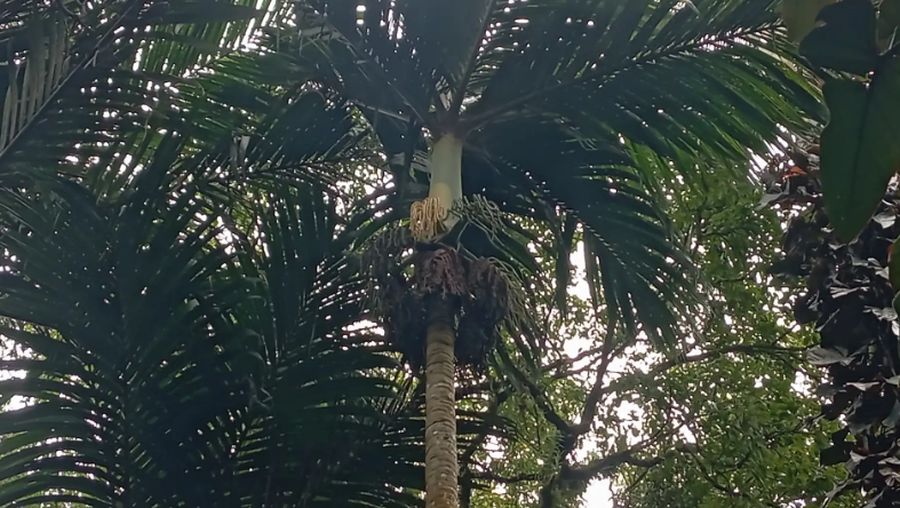

High in Bali’s cool mountain landscapes, a rare palm quietly struggles to survive. The nyabah palm, known scientifically as Pinanga arinasae, exists only in limited highland pockets such as Bedugul and Jatiluwih. Its narrow habitat range has placed it at risk of extinction. That reality has pushed researchers to act before it is too late.
This palm is not just another forest species. It carries cultural and practical value. “The leaves of this plant are used in Hindu religious ceremonies in Bali. Besides serving as an ornamental plant, its young leaves can be consumed, and its fruit can be used as a substitute for areca nut,” explained Arief Priyadi from the Center for Applied Botany Research under the National Research and Innovation Agency, as cited in an official statement on Saturday (14/2/2026).
Protecting the nyabah palm now goes beyond field observation. Researchers from the Plant Genetics Research Group at the Center for Applied Botany Research have turned to genome sequencing as a conservation tool. The method allows scientists to read the plant’s complete genetic code.
Arief described genome sequencing as the process of reading the full set of genetic information, or deoxyribonucleic acid (DNA), contained within an organism. For this species, the effort carries particular urgency. “For the nyabah palm, this method is not merely academic research, but an urgent effort to understand its biological foundation, which has never been conducted before on this plant,” he said.
The process begins with fresh leaf samples collected from the plant. From there, scientists extract and sequence the DNA. The resulting genetic data are carefully annotated and stored in GenBank at the National Center for Biotechnology Information. This makes the information accessible to researchers worldwide.
Anyone who needs the data can download the sequences in standard formats such as fasta and genbank, along with their summaries. The open access system allows users to reanalyze the sequences or compare them with similar genetic data.
Genome sequencing provides more than documentation. It strengthens biodiversity identification efforts and improves conservation strategies. The data also function as a structured scientific archive, serving as a permanent digital genetic blueprint.
Read also: Governor Koster Reminds Investors: Building Bali or Building in Bali?
“If wild populations face extinction, the genetic blueprint will remain stored as a scientific reference for potential reintroduction in the future,” Arief noted.
Further scientific insight comes from Ni Putu Sri Asih of the Center for Biosystematics and Evolution Research. She confirmed that the chloroplast genome of Pinanga arinasae has been successfully characterized and compared within the Arecoideae subfamily.
According to Asih, the findings help close important gaps in palm phylogenetics. The molecular markers identified through this research offer cost efficient tools to measure genetic diversity. They also support conservation planning and sustainable use strategies.
“By reading the complete genetic information or DNA of the nyabah palm, it is hoped that this will benefit further research and utilization for the preservation of this plant,” she concluded.
For a species rooted in Bali’s highlands, the future may now depend not only on the forest, but also on the power of genetic science.